Aging brings natural changes to our bodies, and that includes how we approach training. Adjusting your workouts to match these changes is key to staying strong, mobile, and motivated.
Hall of Fame powerlifter and strength coach Brad Gillingham knows firsthand how to maintain intensity and lift heavy, even later in life. In this article, Brad shares practical strategies and insights you can incorporate into your training to continue building strength, improving mobility, and enjoying your workouts at any age.
The Answer to Stay Strong as You Age
I often get asked how do you keep going at your age? Where do you find the motivation? How do you continue to lift with aging joints? The answer to staying strong as you age is simple: never quit learning, and don’t be afraid to try new exercises. Adding new exercises or changing your workout routine might be just what you need to motivate your training, strengthen weak areas, and continue to achieve your training goals. Finding ways to work on mobility, prehab and the rehab process becomes increasingly important as you age. It’s become easier the past 10-20 years to find examples of different exercises, exercise technique, and workout programs through the internet and social media that is readily available by your phone or computer.
Enter the MobNoid
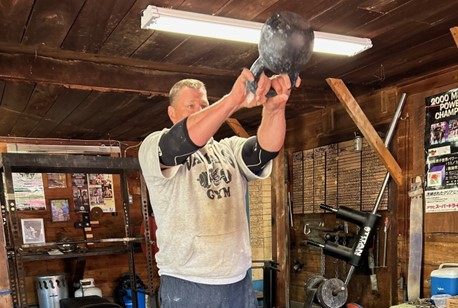
I recently came up with a great new circuit that I call the MobNoid: Mobility (Mob) with Neuro-Priming Optimal Intensity Delivery. The circuit starts with overhead ball slams to crank-up the nervous system (Neuro-Priming). This is similar in concept to a track and field sprinter jumping in place prior to getting in the starting blocks.
The rest of the circuit uses the kettlebell to train mobility, muscular strength, conditioning, and endurance. The benefits of the circuit will change depending on how heavy of a kettlebell you use (Optimal Intensity Delivery) and how much rest you take between sets. The 5 components of this circuit are overhead ball slams, kettlebell swings, goblet squats, devils’ halo, and glute bridge kettlebell pullovers. I developed this circuit after learning about the benefits of the devil’s halo and glute bridge kettlebell pullover from watching an Instagram Reel from @Alex Deravanesian. The kettlebell is such a versatile piece of equipment that it makes sense to develop a circuit that primarily consists of kettlebell movements. This fall I started including this circuit with my wrestling athletes that I coach.
Programming the MobNoid
I typically add the circuit into my own weekly training for mobility and conditioning purposes. With this in mind, I generally use a lighter kettlebell and work at a fast pace. I use some variation in my repetition and sets scheme. Sometimes I train 5 sets of 10, and sometimes 6 sets of 6. When used as a heavier assistance circuit, following a lower body core lift like the deadlift or squat, I typically program in 3 sets of 10 reps with a heavier kettlebell.
This is the concept of Optimal Intensity Delivery. Use of a lighter kettlebell with shorter rest periods is conducive for working on conditioning and mobility. Whereas use of a heavier kettlebell with longer rest periods is more advantageous for developing strength. The MobNoid is always completed in this order:
I try to not take any break between the exercises but prefer to take a short break in between the sets if necessary. Let’s take a look at the individual components of this circuit.
Overhead Ball Slam
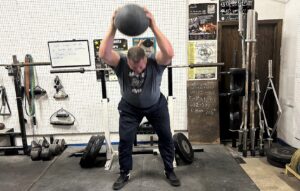
This full body plyometric movement is incorporated into the MobNoid to use Post-Activation Potentiation principals to prime the nervous system (Neuro-Priming) and to get the heart rate up. It also targets multiple muscle groups including legs, core, arms, shoulders, and back.1 The exercise is executed in a standing position with feet positioned at shoulder width and both hands on the ball. The ball is then raised overhead while extending the body up onto the toes. It is then slammed down using the entire body and bracing the core. The ball should be caught on the bounce off the ground in a squat stance then raised above your head to repeat. Make sure to have an aggressive attitude and use near maximal effort!
KB Swing
The basic KB swing is performed by grabbing the handle of the KB with both hands between your legs. The kettle bell is swung like a pendulum, using a hip hinge (think pushing your hips back towards a wall), with straight arms to eye level. This movement should emphasis explosive hip extension of the posterior chain. It will involve the hamstrings, glutes, and lower back. At the top of the movement, you should be standing tall with the core contracted, and glutes squeezed. This exercise has helped me maintain a healthy back during my heavy strength training cycles.
Goblet Squat
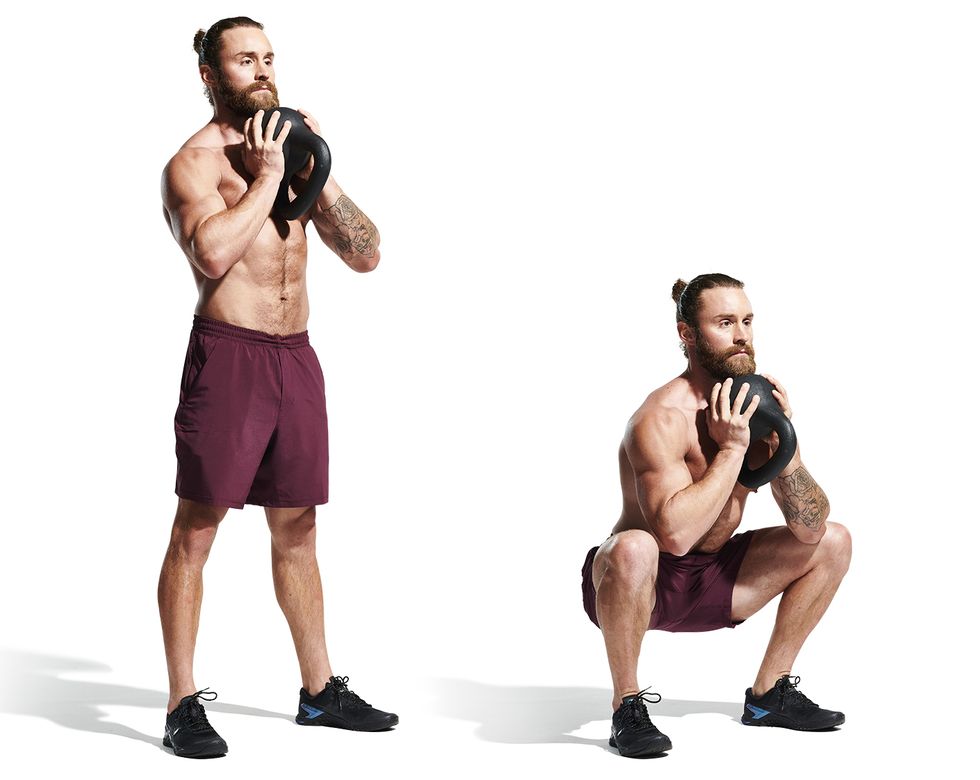
The goblet squat increases hip mobility, and primarily works the quads, and the glutes.2 I started using this exercise as a rehab exercise the past few years. It has helped me to gain the mobility back to be able to full squat after recovering from an injury. The starting position of this movement is achieved by positioning the kettlebell at chest level. Flip the kettlebell upside down and position your hands palms up underneath in a cupping position. Stand with feet shoulder-width apart and begin the downward movement by bracing your core and dropping your butt back and down to lower into a full squat position. Make sure to sit back on your heels and keep your chest up. Return to the starting position by driving through the back of your foot, squeezing the glutes, and extending your knees.
Devil’s Halo

The standing Devils Halo is a full body exercise that works the arms, shoulders, upper back, core, hamstrings, glutes and grip. It trains muscular strength and endurance, rotational strength, shoulder and thoracic spine mobility, core strength, and cardiovascular conditioning.3 I like to stand with my feet slightly wider than shoulder-width and position the kettlebell on the outside of my foot. The kettlebell is picked up by the horn close to the bell and then rotated around the head and set back down on the outside of the opposite foot. The movement is then repeated back and forth for each repetition. Make sure to rotate the kettlebell close to the head and to briefly set it down on the outside of the foot before changing direction.
Glute Bridge Kettlebell Pullover
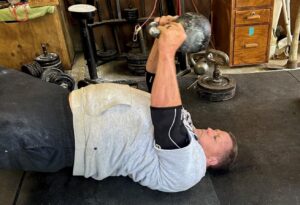
The glute bridge pullover is a great exercise that targets multiple muscle groups including shoulders, glutes, hamstrings, and core muscles. It is also a valuable mobility exercise for working on hip and thoracic mobility. This movement is great for all athletes. Along with my wrestlers, I also include this exercise with the volleyball team I coach.
The exercise starts by getting into the top glute bridge position and placing the kettlebell a couple feet behind the head. With the arms locked out or slightly bent, the kettlebell is gripped by the horn and brought over the head to a position near the waist. It is then returned back to the starting position behind the head. The movement is repeated for each repetition, and the glute bridge is maintained in the upward position throughout the exercise. Each repetition should be slow and controlled. The slower the better.4
Keep Yourself Informed-Stay Strong for Life
Whether you are a competitive athlete or just trying to maintain strength for everyday activities, the secret to staying motivated in your training is to continue to learn new methods to work in your weak areas and provide exercise variation. You can’t always train like you did in your 20’s and 30’s for the rest of your life. If you aren’t doing something similar to the MobNoid circuit, don’t be afraid to start. You can program this circuit as an extra mobility workout or go heavy and use it as a primary assistance circuit following one of your core lifts. You can always include additional exercises and turn this into a bigger circuit. It would be easy to add in pushups, burpees, plyo jumps, and pullups.
Have fun and stay motivated to train! Remain committed to staying strong for life!
Brad Gillingham
CSCS
MSC Southern Utah University
Want to get the most out of your training? Try myHMB®
Explore where to buy below.


References:
- Andrade D, Henriquez-Olguin C, Beltran A, et al. Effects of general, specific and combined warm-up on explosive muscular performance. Biology of Sport. 2014;32(2):123-128. doi:10.5604/20831862.1140426
- Team HE. 5 Benefits of Goblet Squats. Health. September 8, 2025. https://www.health.com/fitness/goblet-squats.
- Solan M. Coming full circle. Harvard Health. August 1, 2025. https://www.health.harvard.edu/exercise-and-fitness/coming-full-circle#:~:text=The%20halo%20simultaneously%20targets%20the,for%20improving%20thoracic%20spine%20mobility.
- Alex Deravanesian on Instagram: “glute bridge pullovers.” Instagram. December 31, 2023. https://www.instagram.com/reel/C1hPyR6LdqZ/.